
S³T · Self-Supervised Self-Distillation over Time
Temporal Self-Distillation: Learning Visual State Tracking in Videos Without Supervision
1ELLIS Institute Finland & Department of Computer Science, Aalto University, Finland
2Mohamed bin Zayed University of Artificial Intelligence, UAE
Qualitative results
Qualitative results on VSTAT
S³T answers all ten video examples correctly, while all five comparison models answer incorrectly. The final tab shows the long-prefix comparisons from the paper.
Source: VSTAT-YouTube
Question
How many different players hit the ball in total?
Reference answer: 10
| Model | Answer |
|---|---|
| S³T | 10 Correct |
| LLaVA-OV-2-8B | 8 |
| Video-Zero-8B | 2 |
| Molmo2-8B | 3 |
| Qwen3-VL-8B | 2 |
| InternVL3.5-8B | 3 |
Source: VSTAT-YouTube
Question
How many different players hit the ball in total?
Reference answer: 4
| Model | Answer |
|---|---|
| S³T | 4 Correct |
| LLaVA-OV-2-8B | 5 |
| Video-Zero-8B | 2 |
| Molmo2-8B | 3 |
| Qwen3-VL-8B | 2 |
| InternVL3.5-8B | 3 |
Source: VSTAT-YouTube
Question
How many times does the white-shirt player score?
Reference answer: 1
| Model | Answer |
|---|---|
| S³T | 1 Correct |
| LLaVA-OV-2-8B | 0 |
| Video-Zero-8B | 2 |
| Molmo2-8B | 2 |
| Qwen3-VL-8B | 2 |
| InternVL3.5-8B | 2 |
Source: VSTAT self-recorded
Question
What animal is drawn on the cup that is seventh from the bottom? (A) Monkey, (B) Lion, (C) Tiger, (D) Zebra.
Reference answer: D
| Model | Answer |
|---|---|
| S³T | D Correct |
| LLaVA-OV-2-8B | C |
| Video-Zero-8B | C |
| Molmo2-8B | C |
| Qwen3-VL-8B | C |
| InternVL3.5-8B | A |
Source: VSTAT-YouTube
Question
How many times does the blue-shirt player return the ball with a backhand?
Reference answer: 3
| Model | Answer |
|---|---|
| S³T | 3 Correct |
| LLaVA-OV-2-8B | 4 |
| Video-Zero-8B | 2 |
| Molmo2-8B | 4 |
| Qwen3-VL-8B | 2 |
| InternVL3.5-8B | 1 |
Source: VSTAT self-recorded
Question
At the end of the video, which position is the cup containing the smaller cup in? Use the viewer's perspective: (A) Right, (B) Left, (C) Center.
Reference answer: A
| Model | Answer |
|---|---|
| S³T | A Correct |
| LLaVA-OV-2-8B | C |
| Video-Zero-8B | C |
| Molmo2-8B | C |
| Qwen3-VL-8B | C |
| InternVL3.5-8B | C |
Source: VSTAT synthetic
Question
A ball starts at corner 1, the top-left. After the box is closed and tilted six times, which corner contains the ball? Corner mapping: 1 top-left, 2 top-right, 3 bottom-right, 4 bottom-left.
Reference answer: 2
| Model | Answer |
|---|---|
| S³T | 2 Correct |
| LLaVA-OV-2-8B | 4 |
| Video-Zero-8B | 4 |
| Molmo2-8B | 3 |
| Qwen3-VL-8B | 4 |
| InternVL3.5-8B | 4 |
Source: VSTAT synthetic
Question
Balls are indexed from left to right in the last frame before any release. Which ball took the longest to fall through the hole after its own release? (A) ball_3, (B) ball_1, (C) ball_2, (D) ball_6.
Reference answer: B
| Model | Answer |
|---|---|
| S³T | B Correct |
| LLaVA-OV-2-8B | A |
| Video-Zero-8B | A |
| Molmo2-8B | A |
| Qwen3-VL-8B | A |
| InternVL3.5-8B | D |
Source: VSTAT-YouTube
Question
How many dolls are there in the opened matryoshka set?
Reference answer: 8
| Model | Answer |
|---|---|
| S³T | 8 Correct |
| LLaVA-OV-2-8B | 6 |
| Video-Zero-8B | 7 |
| Molmo2-8B | 6 |
| Qwen3-VL-8B | 7 |
| InternVL3.5-8B | 6 |
Source: VSTAT-YouTube
Question
How many dolls are there in the opened matryoshka set?
Reference answer: 5
| Model | Answer |
|---|---|
| S³T | 5 Correct |
| LLaVA-OV-2-8B | 4 |
| Video-Zero-8B | 4 |
| Molmo2-8B | 4 |
| Qwen3-VL-8B | 4 |
| InternVL3.5-8B | 3 |
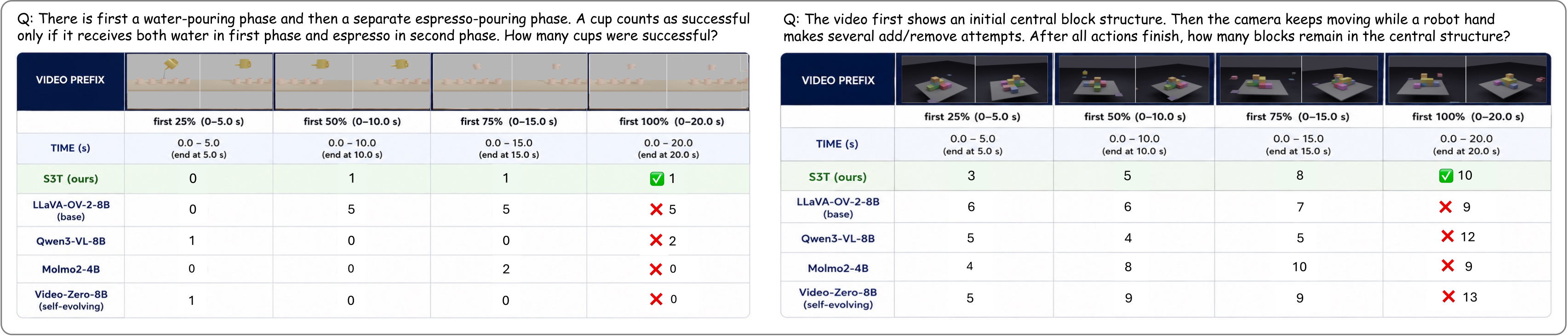
S³T maintains cumulative state across long prefixes in the pouring and block-manipulation examples. The comparison models drift or miscount.
Overview
Abstract
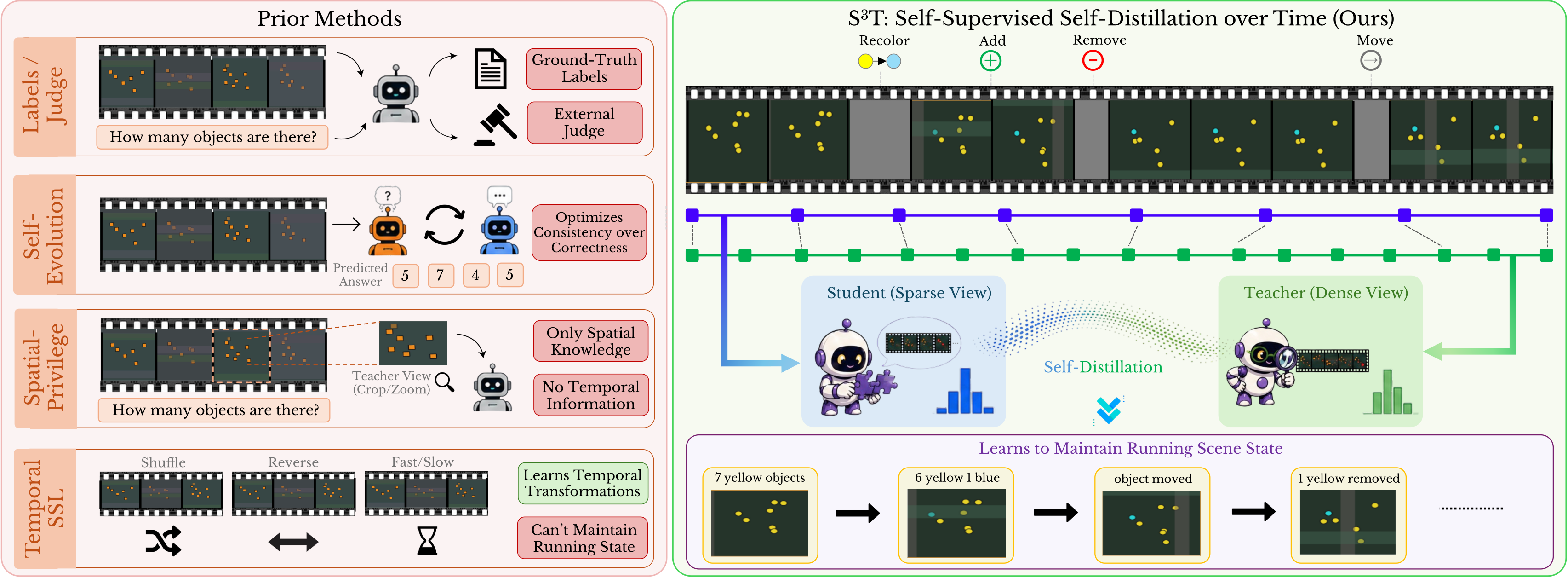
We introduce S³T, Self-Supervised Self-Distillation over Time, a self-contained framework for continuous visual state tracking in videos. A dense reading of an unlabeled clip acts as a privileged teacher for a sparse reading of the same model. The model generates its own target, so training requires no labels, separate teacher, or reward signal and adds no inference cost.
On LLaVA-OneVision-2-8B, a single S³T model improves VSTAT accuracy by 1.74 points, souping two specialists gives 2.38 points, and adapting the vision encoder gives 2.70 points. Training uses only unlabeled synthetic clips. The learned capability also transfers to real videos, improving VSTAT-YouTube cumulative-state questions by 7.95 points and MVBench Action Count by 4.50 points.
Method
Temporal self-distillation from two views of one clip
-
01
Sample the full clip twice
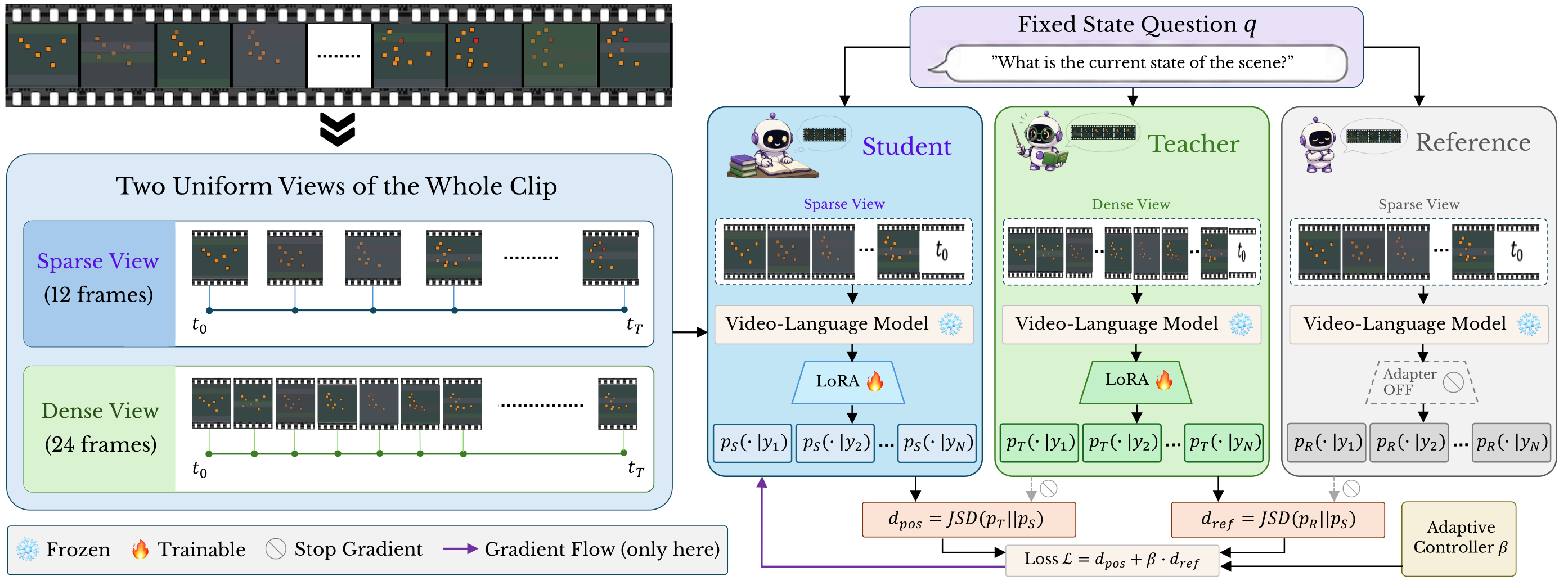
The student reads 12 uniformly spaced frames and the teacher reads 24. Both views cover the same temporal extent.
-
02
Score one generated answer
The sparse student greedily answers a fixed state question. Student, teacher, and reference roles score that answer token by token.
-
03
Update the student adapter
The dense teacher supplies the positive target. The adapter-disabled base model anchors the update, and gradients flow only through the student LoRA.
An adaptive controller adjusts $\beta$ to keep the reference divergence near a fixed set point.
Training data
StateGen
300 unlabeled videos · 512 x 512 · 12 FPS · 20 seconds · 240 frames
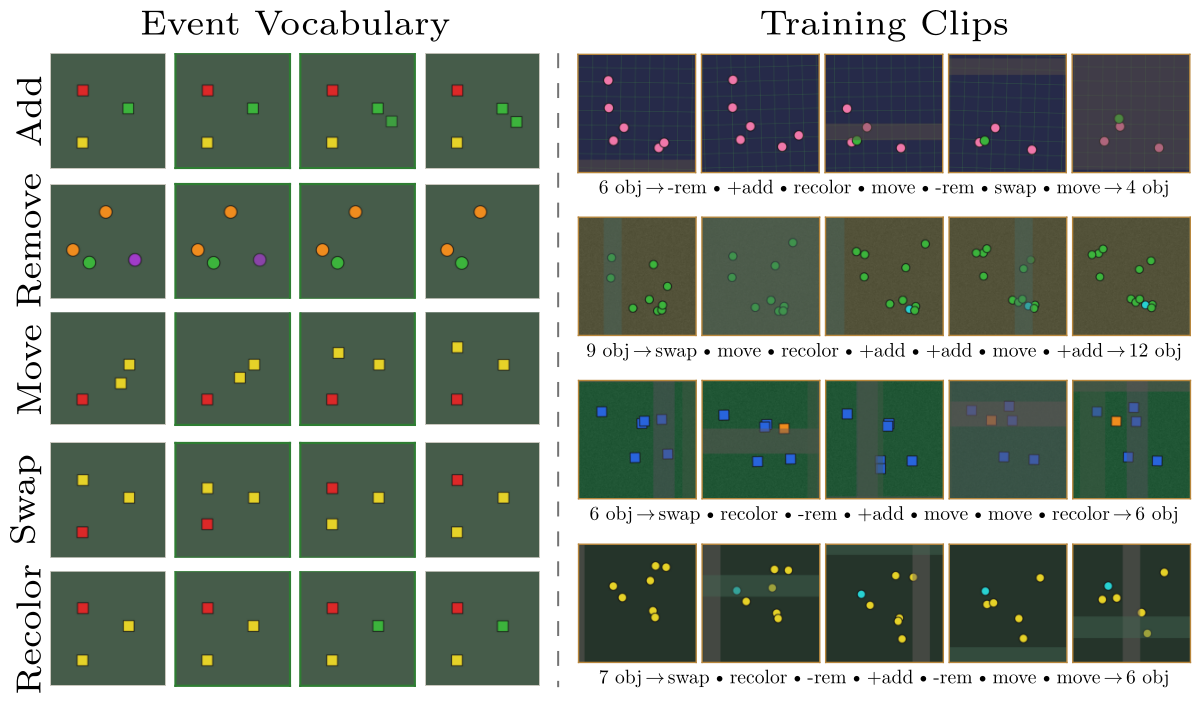
Each clip contains 6 to 15 near-identical entities and 7 to 11 add, remove, move, swap, or recolor events. Occlusion and camera motion continue throughout the clip. State logs and the counts shown in the figure are not used for training.
Results
Results on VSTAT
VSTAT leaderboard
Accuracy (%) on 1,500 VSTAT questions. A dagger marks scores reproduced with our evaluation protocol.
| Method | Avg | State element | State structure | |||||
|---|---|---|---|---|---|---|---|---|
| Count | Loc. | Attr. | Atom. | Seq. | Set | Dict | ||
| Human performance | 90.5 | 92.8 | 89.9 | 86.4 | 93.7 | 77.5 | 90.0 | 92.4 |
| Open-source models | ||||||||
| LLaVA-OV-2-8B | 35.1 | 28.3 | 43.0 | 40.5 | 33.5 | 38.7 | 46.9 | 27.3 |
| LLaVA-OV-2-8B (codec) | 35.0 | 28.6 | 42.0 | 40.6 | 33.9 | 37.0 | 46.3 | 27.6 |
| Molmo2-4B | 34.4 | 31.6 | 39.7 | 34.5 | 37.1 | 33.6 | 36.7 | 27.1 |
| Cambrian-S-7B | 34.2 | 33.2 | 33.6 | 36.9 | 34.0 | 30.6 | 40.2 | 32.5 |
| Molmo2-8B | 34.0 | 30.9 | 37.0 | 37.0 | 34.7 | 36.3 | 39.1 | 27.0 |
| Qwen3VL-8B | 33.2 | 30.9 | 37.0 | 33.9 | 32.4 | 33.3 | 37.9 | 31.5 |
| InternVL3.5-2B | 31.8 | 29.6 | 33.9 | 34.1 | 31.7 | 29.9 | 36.3 | 29.9 |
| Cambrian-S-3B | 31.8 | 29.7 | 32.7 | 35.0 | 32.7 | 31.9 | 35.1 | 27.2 |
| VITA-1.5-7B | 31.5 | 25.5 | 36.3 | 38.6 | 29.4 | 33.0 | 43.1 | 26.3 |
| Qwen3VL-4B | 31.3 | 27.0 | 33.3 | 37.9 | 30.4 | 32.8 | 39.8 | 25.8 |
| InternVL3.5-8B | 30.6 | 25.1 | 33.2 | 39.2 | 26.9 | 33.8 | 41.8 | 28.3 |
| Qwen3VL-2B | 29.4 | 29.4 | 28.2 | 30.5 | 32.5 | 24.9 | 32.1 | 23.5 |
| Cambrian-S-1.5B | 29.3 | 26.0 | 34.1 | 31.0 | 28.0 | 31.0 | 31.8 | 29.3 |
| LLaVA-OV-7B | 28.6 | 20.1 | 34.8 | 39.4 | 24.5 | 30.0 | 43.8 | 25.0 |
| LLaVA-OV-0.5B | 21.3 | 14.6 | 33.9 | 21.7 | 19.7 | 25.8 | 22.2 | 20.9 |
| Self-evolving methods | ||||||||
| Qwen3-VL-4B† | 31.43 | 27.7 | 33.7 | 36.6 | 31.9 | 32.5 | 38.5 | 24.4 |
| Video-Zero-4B† | 31.63 | 27.7 | 34.5 | 36.5 | 32.1 | 32.3 | 37.8 | 25.5 |
| Qwen3-VL-8B† | 34.11 | 32.6 | 37.8 | 33.4 | 35.0 | 33.1 | 37.1 | 30.4 |
| Video-Zero-8B† | 33.89 | 32.0 | 37.2 | 34.3 | 34.1 | 35.5 | 38.3 | 29.1 |
| Qwen2.5-VL-7B† | 31.84 | 25.2 | 37.4 | 39.5 | 28.8 | 39.4 | 41.6 | 26.2 |
| EvoGround† | 32.66 | 26.7 | 36.6 | 40.6 | 29.7 | 39.5 | 42.9 | 27.0 |
| Ours | ||||||||
| LLaVA-OV-2-8B† | 34.74 | 27.7 | 42.0 | 41.4 | 32.6 | 37.0 | 48.6 | 27.4 |
| S³T (SFT teacher) | 34.45 | 26.0 | 42.2 | 43.6 | 30.9 | 38.0 | 50.9 | 27.5 |
| S³T | 36.48 | 30.4 | 41.7 | 43.3 | 35.2 | 39.4 | 47.8 | 28.8 |
| S³T (soup) | 37.12 | 32.4 | 40.7 | 43.0 | 37.2 | 41.4 | 44.9 | 28.4 |
| S³T (soup, + vision enc.) | 37.44 | 32.6 | 42.3 | 42.1 | 37.7 | 42.8 | 45.5 | 27.4 |
Our reproduced LLaVA-OV-2-8B base scores 34.74. Reported gains use this score as the reference.
Per-axis comparison
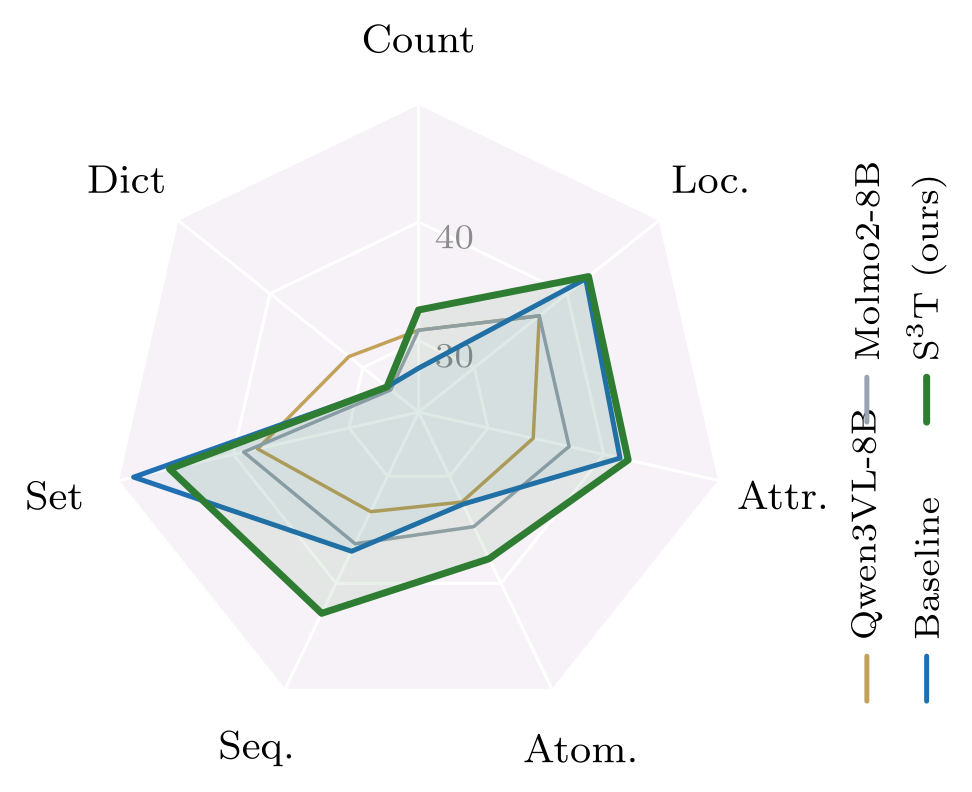
S³T improves the cumulative-state axes against size-matched 8B open models.
Specialists and model soup
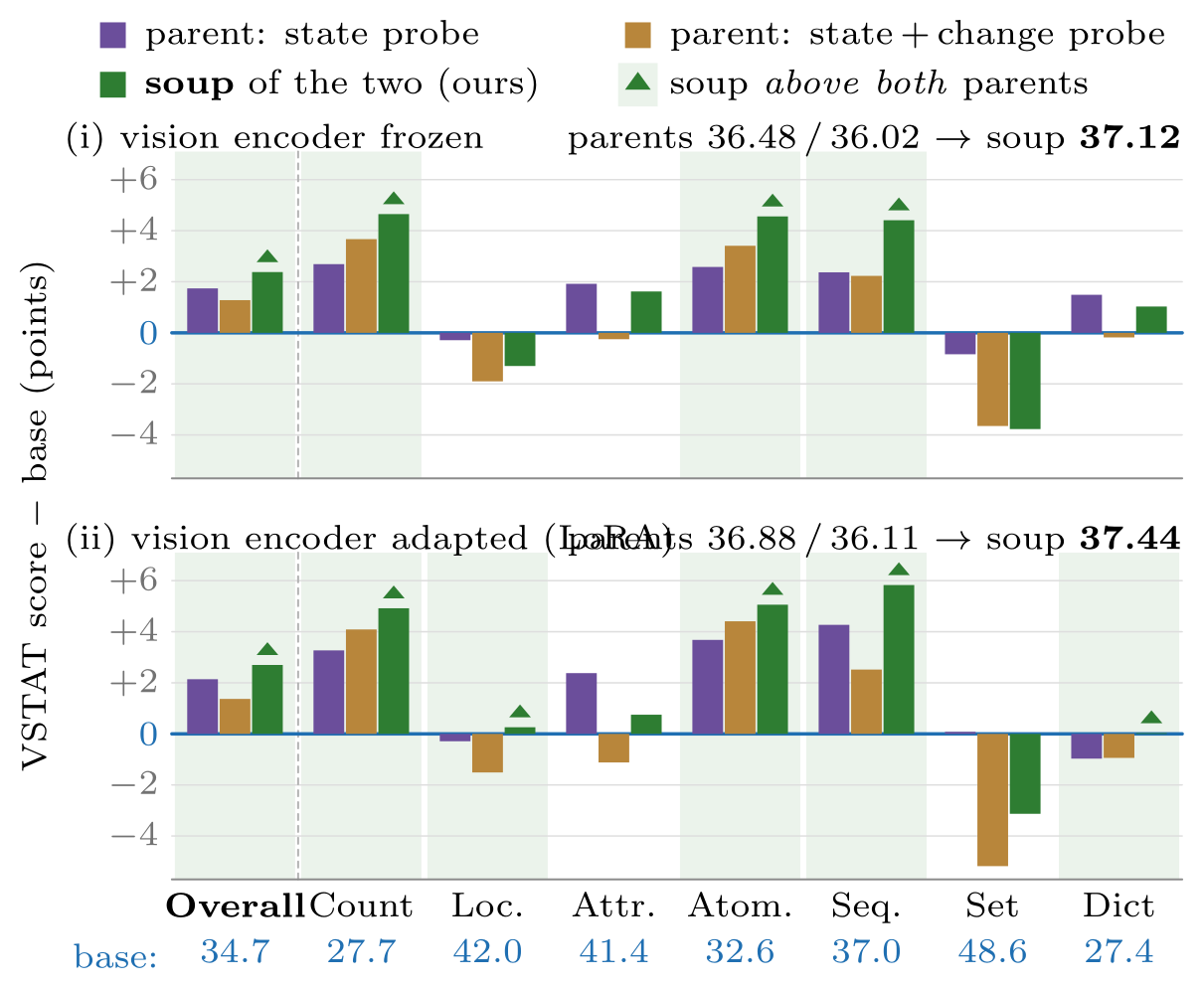
The two state probes give complementary specialists. Their soup improves Count, Atomic, and Sequence with no extra inference cost.
Temporal pretext comparison
| Training objective | Avg | Count | Dict |
|---|---|---|---|
| Base (no training) | 34.74 | 27.7 | 27.4 |
| Frame-order | 34.98 | 27.7 | 30.5 |
| Arrow-of-time | 34.75 | 27.4 | 26.5 |
| Pace | 35.45 | 29.0 | 27.1 |
| Mask-infill | 34.25 | 25.2 | 26.3 |
| S³T | 36.48 | 30.4 | 28.8 |
Every row uses the same model, data, frame budget, and training schedule. Only the prediction target changes.
Component ablations
| Setting | Overall | Count | Dict |
|---|---|---|---|
| Teacher view | |||
| Temporal stretch 12 → 24 (ours) | 36.48 | 30.4 | 28.8 |
| Temporal zoom (windowed) | 33.91 | 26.1 | 25.2 |
| Identical 12 → 12 (no privileged view) | 34.83 | 27.7 | 27.6 |
| Nested 12 ⊂ 24 (student inside teacher) | 34.10 | 25.6 | 25.2 |
| Shifted equal-density teacher (12 → 12) | 35.14 | 28.2 | 27.2 |
| Objective and anchor | |||
| JSD distillation with reference anchor (ours) | 36.48 | 30.4 | 28.8 |
| SFT (cross-entropy on teacher text) | 34.45 | 26.0 | 27.5 |
| JSD to generator's true state | 33.90 | 27.5 | 29.2 |
| No anchor ($\beta = 0$) | 33.68 | 27.3 | 27.7 |
Real-video transfer
Transfer to real videos
| Real-video benchmark | Base | S³T (soup) | S³T (soup, + vis.) |
|---|---|---|---|
| Requires a running tally | |||
| VSTAT-YouTube, cumulative state | 43.41 | +7.35 | +7.95 |
| MVBench, Action Count | 54.50 | +3.00 | +4.50 |
| General video understanding | |||
| TempCompass, multiple choice | 74.49 | −1.01ns | −0.06ns |
| TempCompass, yes/no | 77.62 | +0.24ns | +0.04ns |
| TempCompass, caption matching | 85.70 | −1.00ns | +0.20ns |
| MMVU | 55.20 | 0.00 | 0.00 |
Base gives the original score. S³T columns give the change in accuracy. ns marks a change that is not statistically significant.
Analysis
Teacher view and distillation objective
Student and teacher frame budgets
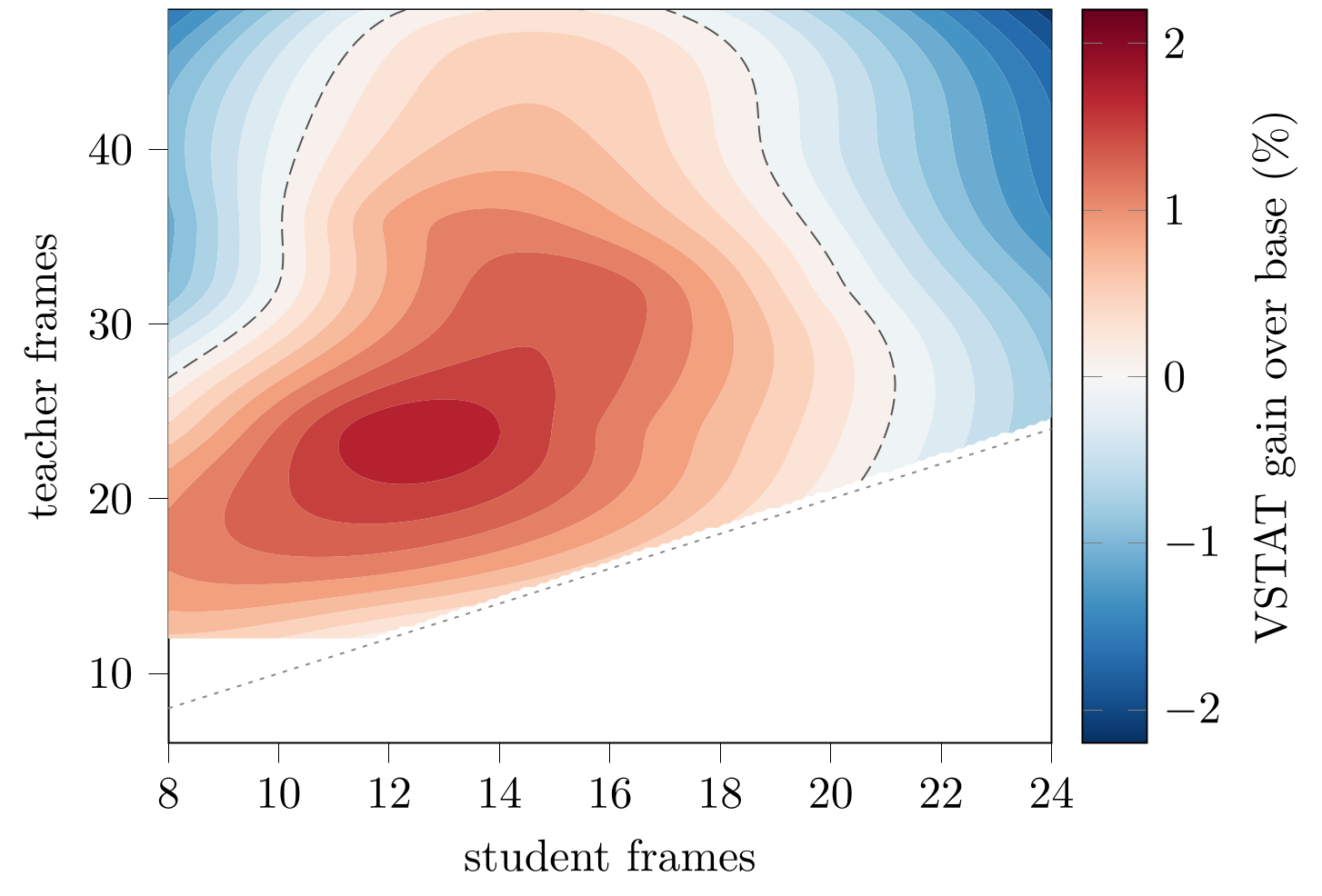
The gain depends on both frame budgets. The strongest region lies near a 12-frame student and a 24-frame teacher.
JSD and KLD objectives
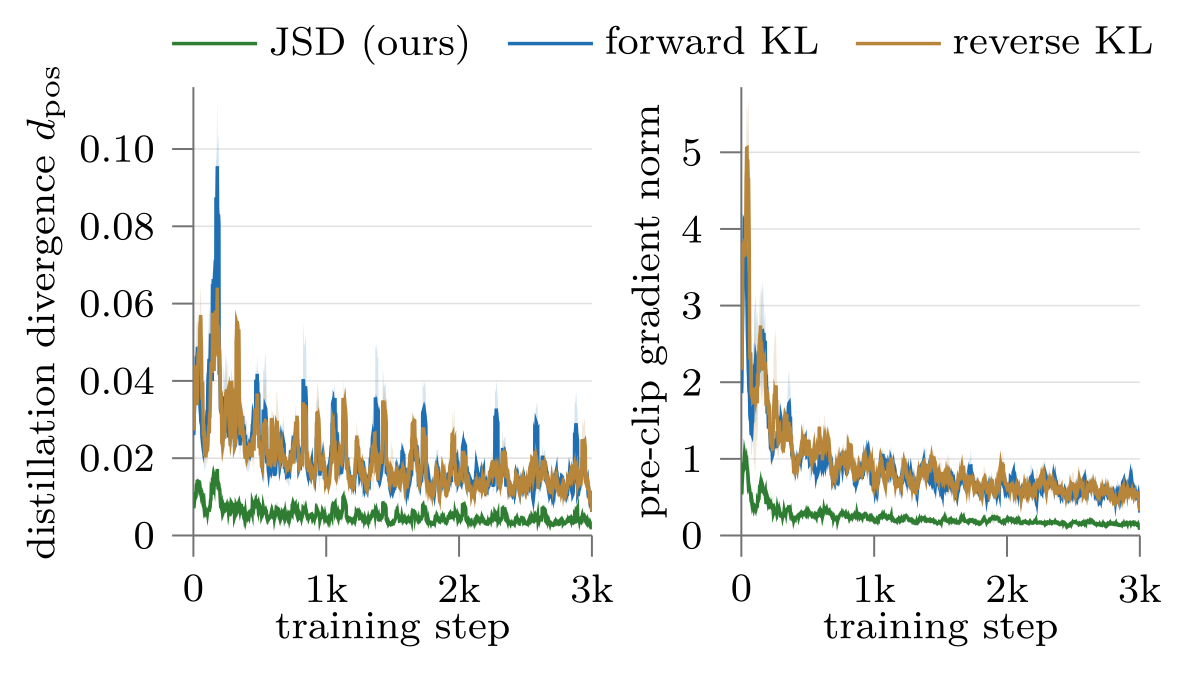
For the same teacher-student gap, JSD gives a bounded objective with smaller losses and lower pre-clip gradient norms than forward or reverse KLD.
Acknowledgements
Acknowledgements
We acknowledge funding from the Research Council of Finland (projects 362408 and 339730). This work was supported by the Research Council of Finland Flagship programme: Finnish Center for Artificial Intelligence FCAI. We acknowledge the computational resources provided by the Aalto Science-IT project.